Movement basics
A bent-knee side plank shortens the supporting lever. Begin with the setup and a small lift rather than treating it as a long endurance hold.
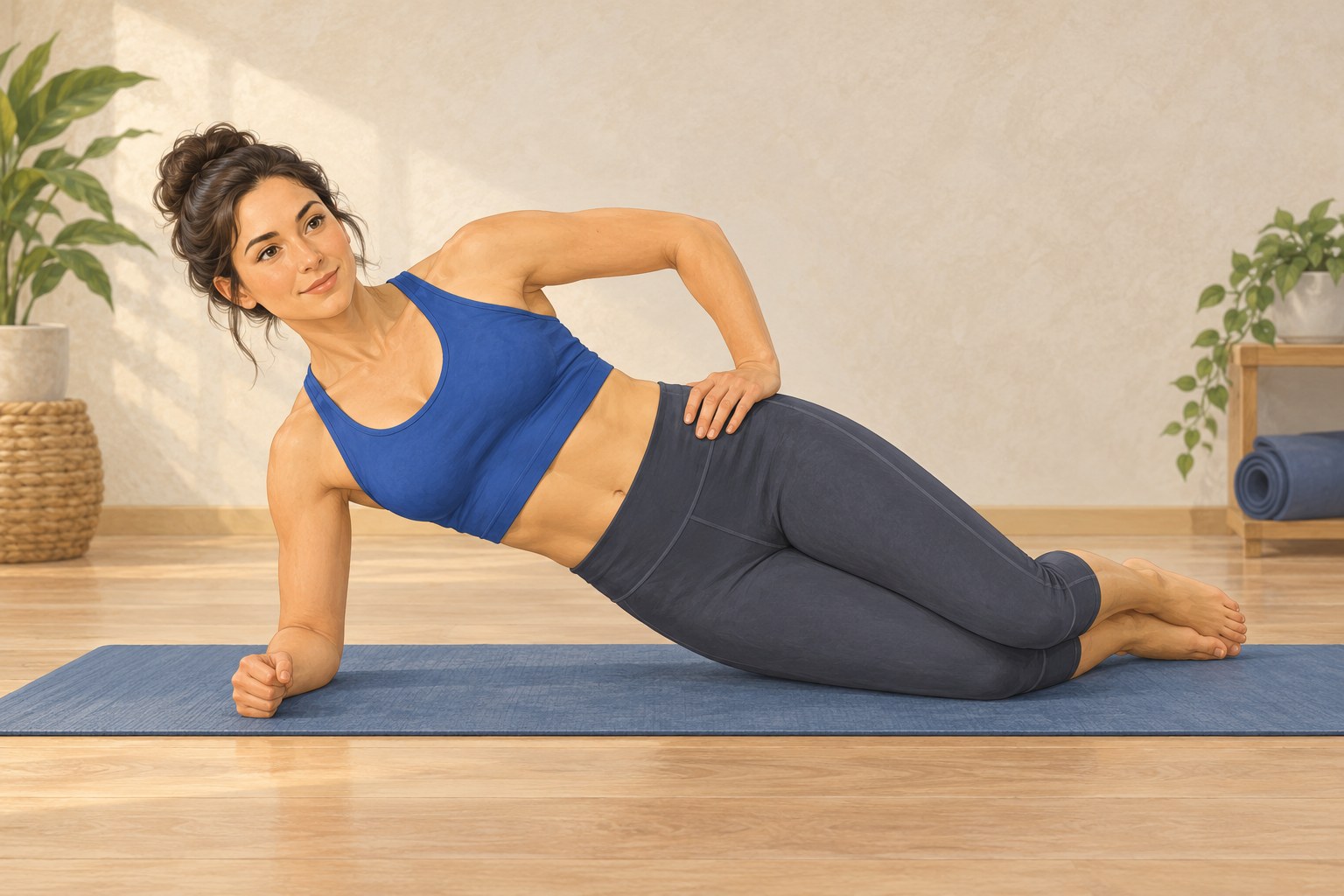
Lie on your side on a firm mat with the knees bent and comfortably stacked. Place the lower elbow beneath the shoulder and rest the forearm on the mat. Keep enough space around you to lower and change sides without rolling into equipment. The supporting arm should not be reaching far away from the body.
Before lifting, check whether pressure through the forearm and bent knees is comfortable. If the shoulder or knee position hurts, choose another exercise with advice rather than adding a thicker unstable cushion and trying again under load. Getting into the starting position should not be a struggle.
Press through the forearm and the supported knees to raise the hips a small amount. Keep the chest facing roughly forwards rather than turning towards the ceiling or the floor. Then lower with control. A short lift followed by a reset can be more useful initially than attempting to hold a full position for a long time.
Keep breathing and avoid shrugging the lower shoulder towards the ear. If the hips roll backwards or the supporting arm begins to slip, lower and rebuild the setup. Your upper hand can rest comfortably rather than reaching overhead, which would add another balance demand.
There is no need to reproduce a perfectly straight long-leg side plank. This is a different version with its own contact points. Ask an instructor to check the alignment and the appropriate range instead of judging it solely against a photograph.
Lower fully before turning and arranging the opposite side. Check the elbow position again; it is easy to place one side differently while trying to hurry through a timed station. Clarify whether the programme's time applies to each side or to both together.
A side that feels less coordinated does not automatically need extra repetitions. Record the difference and ask for feedback if it persists. Stop for pain or a feeling of instability. Longer holds and straightened legs are optional changes to discuss later, not requirements for this exercise to be worth practising.