Home & outdoors
A timer can organise a session, but its beep does not decide whether the next repetition is a good idea.
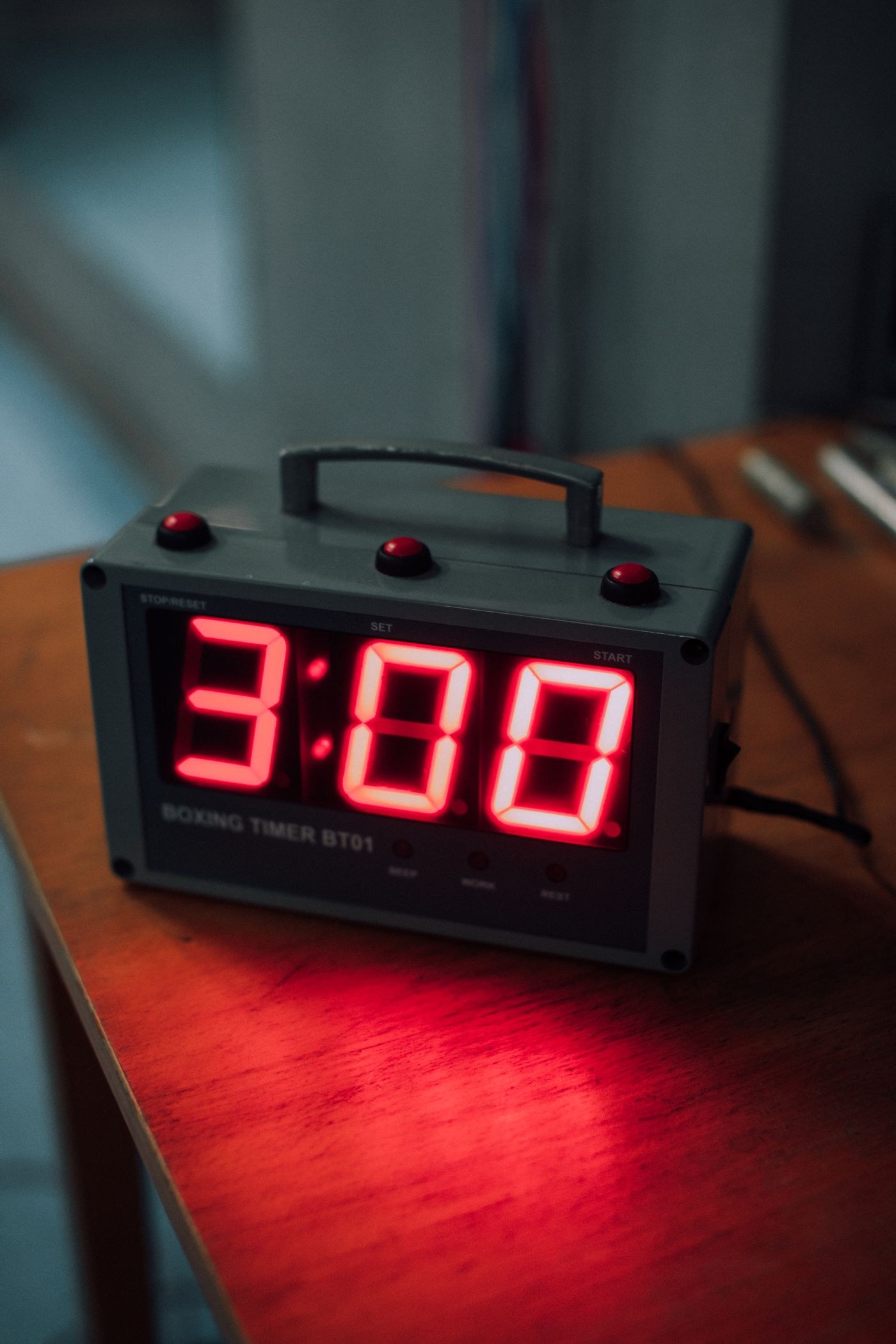
Use the timer to mark a planned work period, a rest or a transition. Those are different tasks. If you need time to put down weights and move to another position, include that time explicitly rather than counting it as recovery and then rushing the next start.
When practising an unfamiliar movement, a small number of controlled repetitions may be easier to manage than a timed interval. A countdown can encourage you to keep going after concentration or technique changes. You can stop early, even if the screen still shows time remaining.
Set the timer before picking up equipment. Try a short test so you know the start delay, volume and pause behaviour. Some apps restart an interval when resumed; others continue from the pause point. Discovering this during a set makes the timer more distracting than useful.
Place the display where it can be checked without turning away from the movement. If looking at the numbers changes your posture, use a suitable audible signal or pause to check. Do not hold a phone in one hand during an exercise that needs both hands free.
Rest until you are ready to perform the next movement with control, rather than treating the programmed rest as an absolute maximum. If you repeatedly need more time, change the settings for the next round. A timer should reflect the session you can perform, not force you into a generic sequence.
Record useful observations afterwards: whether transitions were cramped, whether the signal was clear and whether the work periods were appropriate. These details are more informative than counting how many seconds you managed to fill. If an interval format makes you hurry, remove it for that exercise and practise at a deliberate pace.
In a class, the instructor's clock may serve a whole group. Ask how to take an additional pause or use a shorter work period. Stop if you feel pain, dizziness or otherwise unwell, and seek suitable advice rather than waiting for the round to finish. The timer is an organising tool, not a measure of what your body must tolerate.