Training kit
Choose a first pair of dumbbells around movements you can perform with control and a place where the weights can be stored safely.
The same load can feel very different in a row, a press or a carry. A pair chosen for one movement may be unsuitable for another. If you are learning, ask an appropriately qualified instructor to help you identify a manageable starting load and practise the technique before buying a heavy set.
Do not use an online chart based only on age or body size as a prescription. You should be able to set the weights up, perform the intended movement and put them down under control. The purchase needs to account for all three, not just whether you can lift the weight once.
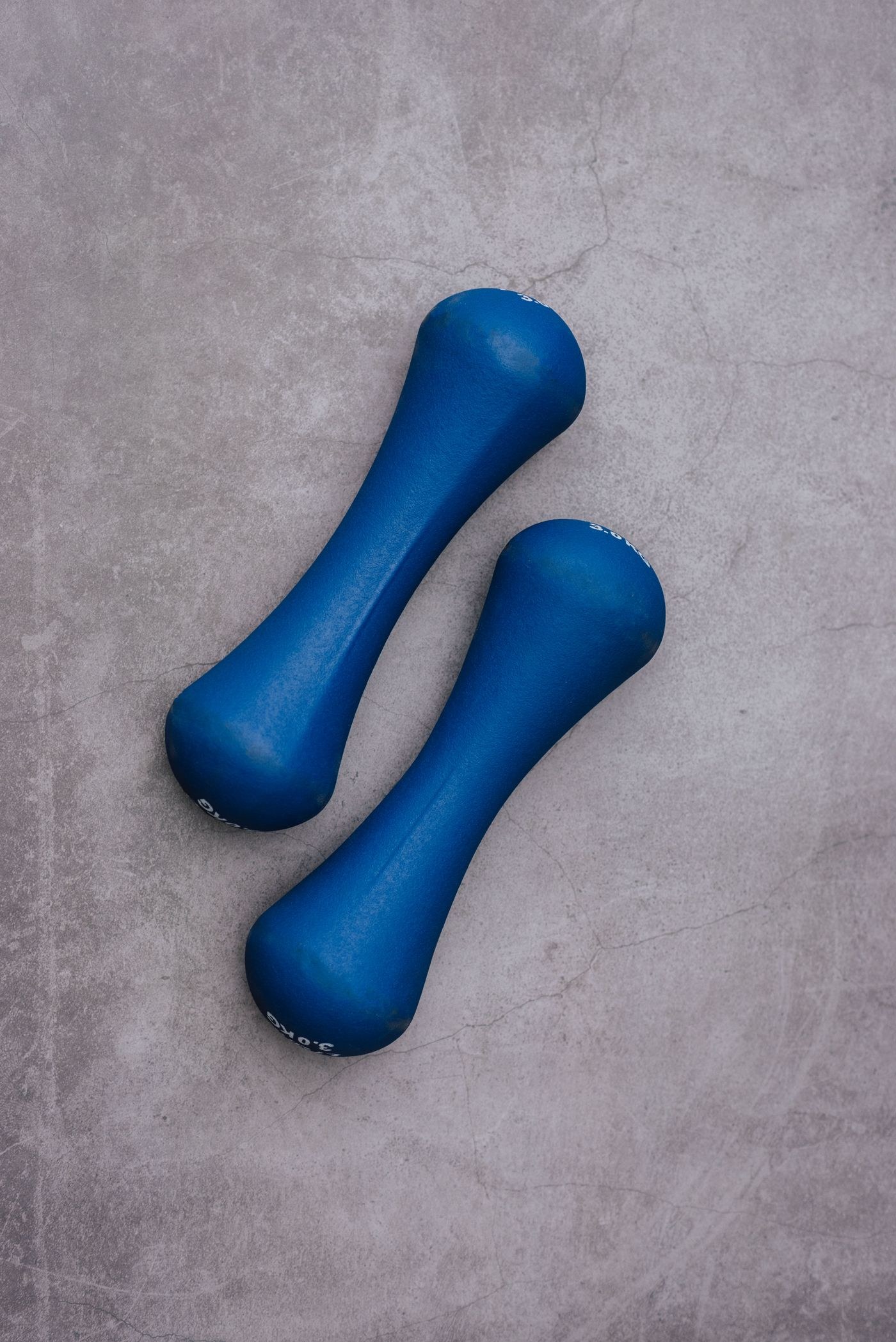
Check whether your hand can wrap comfortably around the handle and whether the surface feels secure without being abrasive. Look for sufficient clearance between the heads and your hand. A coating can change the feel and dimensions even when two weights have the same labelled mass.
Flat-sided heads may reduce rolling, but they still need a stable storage place. Round heads require particular attention to where they are set down. Neither design should be dropped onto a domestic floor. Check the manufacturer's intended use and flooring advice, especially if you live above another household.
Fixed dumbbells remove the need to change a mechanism between exercises. That can be useful when you are learning and want to concentrate on setup and movement. Their disadvantage is storage: several pairs take more space and may require a suitable rack. Measure the available area before deciding that a full range is economical.
An adjustable pair can offer more loads in one system, but you need time and room to make each change correctly. Check the smallest available increment as well as the maximum load. A large jump between settings may not suit the progressions you have been advised to use. The maximum number on the box is not necessarily the most relevant specification.
Consider whether you truly need a pair for the exercises in your plan. Some movements use one weight, while others require two matched loads. Buying a single heavier dumbbell to save money does not recreate a movement designed for two lighter ones. Ask for a suitable programme using the equipment you can afford and store, rather than adapting every exercise around an unsuitable purchase.
One suitable pair can be enough to begin practising selected movements, but it will not necessarily cover every exercise. You can use lighter resistance or a different exercise for movements that need it. Do not buy an excessive range before you know which weights you actually use.
Compare the cost with the space required. Fixed weights are simple to handle but take more room as the collection grows. Adjustable designs save some storage space but introduce locking mechanisms and a different setup process. Read those instructions before deciding that convenience alone settles the choice.
Inspect the delivered pair for damage, loose parts or a mismatch with the description. Keep the model details and purchase record. Store the weights low and secure, away from children and walking routes. If the only available storage requires lifting them above shoulder height or balancing them on a narrow shelf, solve the storage problem before adding them to the room.